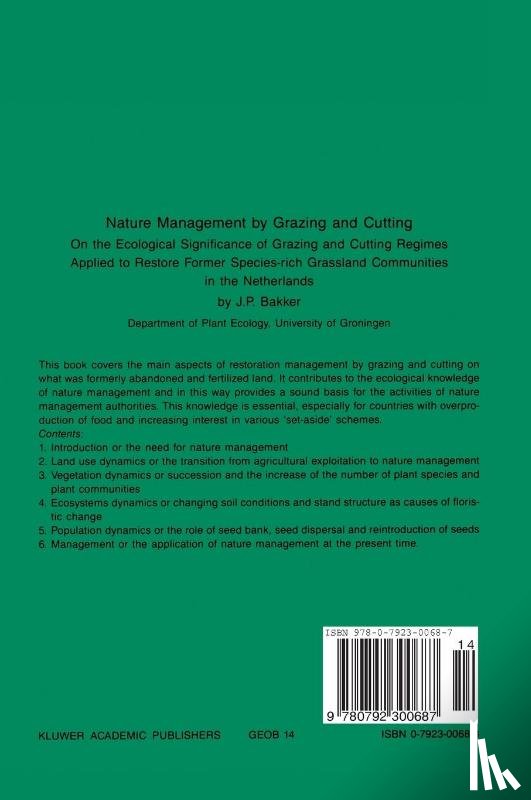
On the ecological significance of grazing and cutting regimes applied to restore former species-rich grassland communities in the Netherlands
Omschrijving
A. Background and scope of the study .............. . 3 1. General .................. " ,-, ........... 11 B. Abandoned and marginal agricultural grasslands ... . 5 2. Some equilibrium models explaining species di- 1. Definition ............................... . 5 versity ., ....... , ,-.... , .................. 11 2. Inland areas in western Europe ............. . 6 3. Change of the steady state .. , .. , ............ 14 3. Ca. stal areas in western Europe ............ . 8 4. Dispersal of plant species ................ , ,- 14 C. Nature mc.nagement practices ................... . 10 5. 'Ecotypic' diversity .. , ..................... 15 D. Theoretical considerations on nature management 6. Patterns in plant communities ............... 15 with special reference to diversity ............... . 7. ............. ,. 11 Implications for management 16 LA. Background and scope of the study (Klapp, 1965), Belgium (Van Hecke, Impens & Behaeghe, 1981) and the Netherlands (Oomes & The degradation of flora and vegetation in natural Mooi, 1981; Elberse, Van Den Bergh & Dirven, and semi-natural landscapes has become a matter 1983; Willems, 1983A).
Ik heb een vraag over het boek:
‘Nature Management by Grazing and Cutting - ’.
Vul het onderstaande formulier in.
We zullen zo spoedig mogelijk antwoorden.
Wij respecteren je privacy
We gebruiken cookies om bezoek te meten, Boekstra te verbeteren en om advertenties van Google op je interesses af te stemmen. Je kunt de site hoe dan ook gewoon blijven gebruiken — ook als je weigert. Meer info