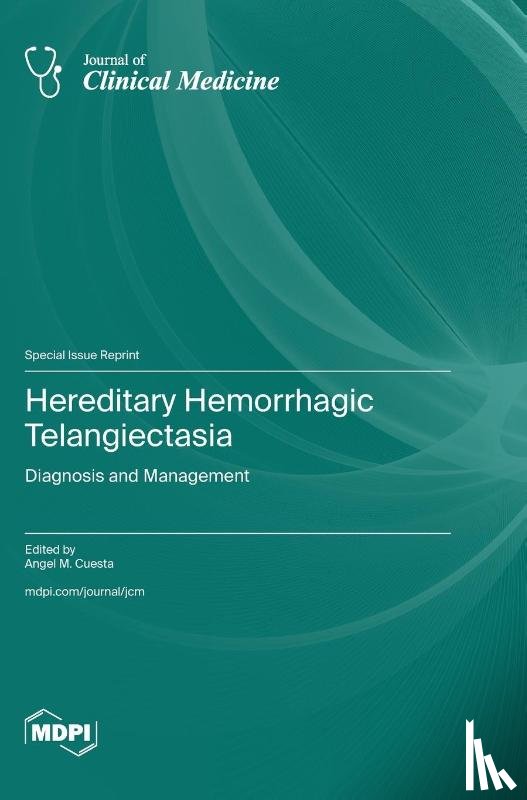
Hereditary Hemorrhagic Telangiectasia (HHT), or Rendu-Osler-Weber syndrome, is a dominantly inheritable rare disease with a prevalence of 1:5,000 - 10,000 people. The diagnosis of HHT, as a rare disease, follows the Curaçao Diagnostic Criteria: Nosebleeds (epistaxis), whether spontaneous or recurrent; (multiple) telangiectases at characteristic sites, including the lips, oral cavity, fingers and nose; Internal lesions: arteriovenous malformations (AVMs) or telangiectases in the stomach, lungs, liver, brain and spinal cord; Family history: a first-degree relative with HHT, according to these criteria. When a patient meets at least three of these criteria, it is considered definite that they have HHT. Nowadays, three subtypes of HHT have been identified. HHT type 1 refers to mutations on the endoglin gene ENG; HHT type 2 refers to mutations on the activin A receptor-like type 1 (ACVRL1) gene; and the third one, named juvenile polyposis-hereditary hemorrhagic telangiectasia (JPHT or JPHHT) overlap syndrome, refers to mutations on the gene MADH 4. There are two other subtypes (HHT-3 and 4) in which the mutations have not yet been completely identified, but they are known to be located on the 5q31.3-q32 and 7p14 chromosomal regions, respectively.
Ik heb een vraag over het boek:
‘Hereditary Hemorrhagic Telangiectasia - Cuesta, Angel’.
Vul het onderstaande formulier in.
We zullen zo spoedig mogelijk antwoorden.