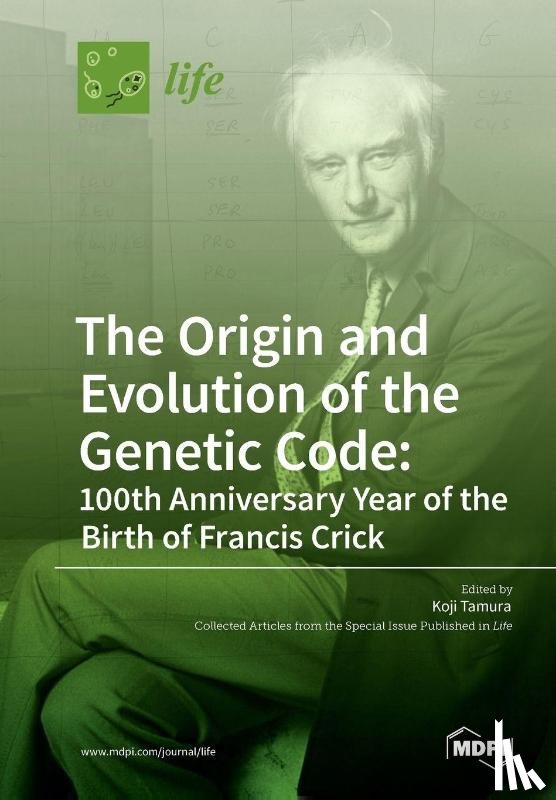
100th Anniversary Year of the Birth of Francis Crick
Omschrijving
The genetic code is one of the greatest discoveries of the 20th century as it is central to life itself. It is the algorithm that connects 64 RNA triplets to 20 amino acids, thus functioning as the Rosetta Stone of molecular biology. Following the discovery of the structure of DNA by James Watson and Francis Crick in 1953, George Gamow organized the 20-member "RNA Tie Club" to discuss the transmission of information by DNA. Crick, Sydney Brenner, Leslie Barnett, and Richard Watts-Tobin first demonstrated the three bases of DNA code for one amino acid. The decoding of the genetic code was begun by Marshall Nirenberg and Heinrich Matthaei and was completed by Har Gobind Khorana. Then, finally, Brenner, Barnett, Eugene Katz, and Crick placed the last piece of the jigsaw puzzle of life by proving that UGA was a third stop codon. In the mid-1960s, Carl Woese proposed the "stereochemical hypothesis", which speculated that the genetic code derives from a type of codon-amino acid-pairing interaction. The origin and evolution of the genetic code remains a mystery despite numerous theories and attempts to understand these. In this Special Issue, experts in the field present their thoughts and views on this topic. Because 2016 commemorated the 100th anniversary of the birth of Francis Crick, the Guest Editor of this Special Issue also dedicates all articles included herein to the memory of Francis Crick.
Ik heb een vraag over het boek:
‘The Origin and Evolution of the Genetic Code - Tamura, Koji’.
Vul het onderstaande formulier in.
We zullen zo spoedig mogelijk antwoorden.