Omschrijving
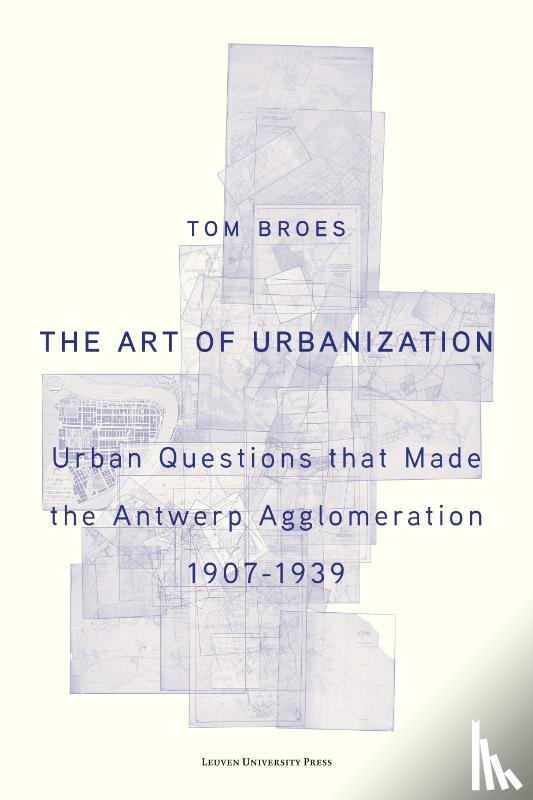
Forgotten chapter in early 20th-century European planning history, offering a fresh perspective on urbanism, grounded in a theory of urbanization The Art of Urbanization reexamines a forgotten tradition in Belgian and European planning history, reconstructed through a longitudinal analysis of the Study Committee of the Antwerp Agglomeration (1907-1939). Against prevailing trends, Antwerp’s urban expansion was not the product of rational master planning, but evolved gradually through collective and pragmatic responses to emerging urban questions.
Drawing on a wide range of historical sources and richly illustrated, the book reconstructs how numerous sub-plans – each addressing economic, sociocultural, political and ecological needs – coalesced into the incremental components of a reasoned and dynamic urban agglomeration.
As it engages with classical concepts in urban theory and global urban history, The Art of Urbanization is presented as a generative, redistributive, reproductive, and situated worlding practice – offering a fresh perspective on urbanism that resonates in our current age of (planetary) urbanization. 'The Art of Urbanization' reexamines a forgotten tradition in Belgian and European planning history, reconstructed through a longitudinal analysis of the Study Committee of the Antwerp Agglomeration (1907-1939). Against prevailing trends, Antwerp’s urban expansion was not the product of rational master planning, but evolved gradually through collective and pragmatic responses to emerging urban questions.
Drawing on a wide range of historical sources and richly illustrated, the book reconstructs how numerous sub-plans – each addressing economic, sociocultural, political and ecological needs – coalesced into the incremental components of a reasoned and dynamic urban agglomeration.
As it engages with classical concepts in urban theory and global urban history, 'The Art of Urbanization' is presented as a generative, redistributive, reproductive, and situated worlding practice – offering a fresh perspective on urbanism that resonates in our current age of (planetary) urbanization. Foreword
Acknowledgements
Introduction. Urbanization in Theory, History, and Practice
The Art of Urbanization in theory: On urban questions and reproduction
Contemporary critique of urbanization
Grounding urbanism in a theory of urbanization
Aspects of the Art of Urbanization in international urbanism discourse
The Art of Urbanization in history: Requalifying the legacy of Belgian planning
Pragmatic urbanisms for the open-ended agglomeration
Requalifying the historical significance of Belgian planning
The Art of Urbanization in practice: The study of reason and intent
The SCAA as a social platform for urbanization
Specific situation—productive universal?
Chapter 1. The Question of Metropolitan Governance: Confederal municipalism, provincial policy entrepreneurship, and programmatic urbanization
Governing unbounded urbanization
The impossibility of pure and plain annexation
Intermunicipal cooperation under provincial supervision
Municipal confederalism
Three forms of municipalism for three regimes of urbanization
Mythical municipalism and urbanism
Managerial municipalism and cheap urbanization
Confederal municipalism and programmatic urbanization
Provisional provinces
The SCAA, policy entrepreneurship, and the relative ideal
Urbanization as the work of men
The relative ideal
Policy-entrepreneurship in-between realpolitik and ideology
Grounding urban governance in the process of urbanization
Chapter 2. The Question of Urban Ways: The urbanization of technology and ecological infrastructures
The urbanization of technology
Sanitary amenities as a techno-natural prerequisite for urbanization
Les ‘Hommes de l’égout’
Technology deduplicating nature
The necessity of incremental implementation
Toward a metropolitan grid: The modern road as urban project
Les ‘Hommes de la route’
Building a one-mile metropolitan grid, a work for the long haul
An urban profile for the modern road
The urbanization of railway infrastructures
From ambitious plans to local porosity
Radically careful infrastructures for an urban ecology?
Chapter 3. The Question of Collective Consumption: Generative urbanization and spatial differentiation securing the right to the city
Generative urbanization rather than parasitic urbanization
Parasitic urbanization and uneven development
Generative urbanization and spatial differentiation
The SCAA’s approach to generative urbanization
Parks and squares as a public backbone for continued accumulation
Saving public parks from private subdivision
Weaving parks into the urban fabric
Urban parks and the right to the city
Squares as communal spaces or civic centralities
Positive externality and continued accumulation
Sports facilities for a new urban imagination
Polo and golf clubs: Playgrounds for Antwerp’s high society
Antwerp’s major stadiums: Sports for the common man
A sports dome and aviation plains for a new metropolitanism
Private capital stimulating public welfare?
The urbanization of public transport
Vicinal railways penetrating the historical city
Urban trams breaking out of the historical city
Practicing generative urbanization
Chapter 4. The Housing Question: Real estate agency and the urbanization of taxes on urban rent
The consolidation of real estate agency
Real estate and urbanization
The professionalization of real estate agency
An urban revolution avant la lettre
Urbanizing the agglomeration as a prerequisite for the urbanization of capital
The rise of an autonomous secondary circuit of capital
Providing a permanent flux of ‘urbanizable land’
A pertinent critique of capitalist urbanization
An urbanistic turn: Redistributing class-monopoly rent
Urban rent in Belgian politics
Uniform tax regulations for the agglomeration?
The municipalization of land
Negotiating urban fortunes
A socially fair redistribution of urban fortunes
A job well done, but what if?
Chapter 5. The Question of Aesthetics: Spatial agency and L’esthétique intégrale for an architecture of urbanization
Subordination and subsistence of aesthetics in an urbanizing world
The SCAA’s loose ideas and efforts
The persistence of the aesthetic question
International master-urbanists and the critique of liberal irony
A local plea for a worldly contingency
The critique of the master urbanist as a liberal ironist
Situated architects and spatial agency
The ‘young watchmen’ and the practice of architecture in an age of urbanization
Four forms of agency for a concrete utopia
The SCAA’s enabling role
L’Esthétique intégrale for an architecture of urbanization
Chapter 6. The Sociocultural Question: Urbanization as the work of city-amateurs
Urbanization as a sociocultural practice
Urbanization and public opinion
Amateur readings of urbanization
Reciting and exhibiting urbanization: The SCAA in search of an audience
Exploring communication channels
The 1910 exhibition: Publicity campaign for the urban elites
The 1913 event: Exhibition at a tipping point
The 1932 Exhibition: Immersing large crowds within the relative ideal
Experiencing and exploring urbanization: Civic festivities and regional tourism
The 1920 Olympics and the 1930 World Fair
Les Amis des Parcs d’Anvers and Les Environs d’Anvers
Amateurism as precondition for urbanization as a sociocultural practice
Post Scriptum. Final reflections on the Art of Urbanization
The Art of Urbanization: Bridging urban theory and urban history?
The Art of Urbanization: Belgian practice for a different kind of planning history?
The Art of Urbanization: Grounding a notion of urbanism in urban theory?
Appendix. List of SCAA Meeting Minutes
Notes
List of Abbreviations
Bibliography
Illustration Credits
Index