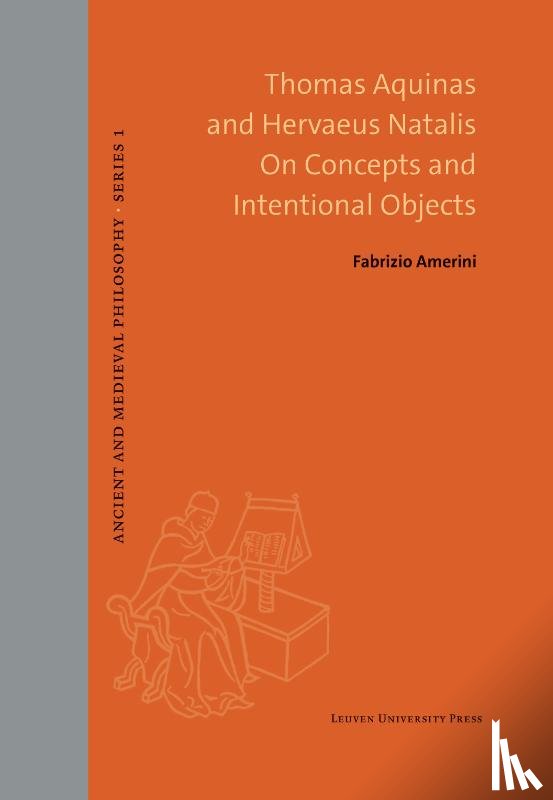
Thomas Aquinas and Hervaeus Natalis on Concepts and Intentional Objects

Amerini, Fabrizio

Omschrijving

Analysis of two key medieval reflections at the intersection of our mental representations and external reality Thought, in a sense, transforms the world. When we think of a particular thing – Charlie the dog, for example – we always think of it in a universal way: as a dog. Through this act of thinking, Charlie comes to exist in our mind and becomes the dog that is the object of our thought. Explaining how our act of thinking relates to and transforms the reality around us is often considered the hallmark of the modern age. Yet the Middle Ages offer illuminating examples of speculation on the human mind and how it functions. This book explores the views on mental acts, concepts and objects of the mind of two of the most eminent Dominican authors of the late Middle Ages: Thomas Aquinas and Hervaeus Natalis, one of his closest followers. By putting Aquinas and Hervaeus Natalis directly in conversation with each other Amerini proposes a new interpretative framework for understanding their philosophy of mind and traces the origins of modern accounts of the intentionality of the mind. Introduction Universities, jubilees, and transnational ties Introduction The first university jubilees Writing university history Histories of Leuven University The university in a transnational landscape Leuven University from 1425 to 2025 Chapter 1 The transnational character of the early university Introduction Medieval universities before 1500 University, religion, and politics The foundation of Leuven University The recruitment of professors Determining the geographical background of the early staff The geographical background of professors in church law The geographical background of professors in civil law The geographical background of professors in medicine The geographical background of professors in theology The geographical background of professors in the arts Determining the educational background of the early staff The educational background of professors in church law The educational background of professors in civil law The educational background of professors in medicine The educational background of professors in theology The educational background of professors in the arts A life after Leuven? Conclusion: becoming self-sufficient  Chapter 2 Humanist entanglements Introduction Vives and Erasmus: Leuven’s early humanist luminaries The networks of Vives and Erasmus Humanism in Leuven before 1517 The foundation of the Collegium Trilingue The (trans)national teaching staff of the Trilingue A typical humanist: the research-minded traveler Campensis A typical humanist: the printing endeavors of Rutgerus Rescius A typical humanist: Petrus Nannius’s correspondence network European students at the Trilingue Trilingue students in Europe: the linguist Clenardus Trilingue students in Europe: the diplomat Busbequius Trilingue students in Europe: the anatomist Vesalius An example worth following Conclusion: a merging of university and humanist networks Chapter 3 On the frontlines of faith Introduction Counter-Reformation and higher education in the seventeenth century Leuven and the Irish college network Irish history from Leuven Irish Catholicism in Leuven The precarious position of Catholicism in the northern Low Countries Jesuits vs. Dutch secular clergy Jesuits and the Leuven Augustinian tradition Jesuits and Jansenists St. Anthony’s, Pulcheria, and Alticollense Toward the founding of an American College The accomplishments of the American College Leuven as an example of Catholicism and scholarship Latin America in Leuven Over four centuries of mission colleges Chapter 4 Collections as transnational spaces Leuven’s first central library Catholic patristics and ecumenical medicine? Collections, teaching, and research in the nineteenth century The university collections in the mid-nineteenth century The roots of the botanical garden The botanical garden’s transnational branches The birth of the zoological collection Van Beneden’s transnational paleontological networks The genesis of the Biblical Museum A network of scholarly clergymen The destruction of the library International collaboration toward a new library Reassembling the lost collection The construction of a brand-new library University collections and transnational networks Chapter 5 The colonial involvement of Leuven University Universities and colonialism The first colonial programs at Belgian universities A Catholic colonial student movement Collecting the colony After the First World War First steps into the colony The early expansion of FOMULAC: 1926-1931 The rapid expansion of FOMULAC: 1931-1945 Agricultural education in the Congo Toward a university: University Centre Lovanium The founding of a full university: Lovanium Kimwenza Lovanium and Leuven University after Congolese independence Leuven and Congo: a retrospective Chapter 6 Research institutes as transnational hubs The rise of research institutes The Higher Institute of Philosophy The laboratory for experimental psychology The founding of the Husserl Archives The growth of the Husserl Archives Penicillin and the prelude to the Rega Institute Polio vaccines and the founding of the Rega Institute Developing viral treatments at the Rega Institute Bananas come to Belgium Banana research, conservation, and distribution in Leuven The KU Leuven Institutes of the twenty-first century Conclusion: research institutes between 1938 and 2025 Epilogue Uniqueness and typicality Change and continuity Recent transnational developments The merits and promise of transnational university histories Notes
€ 55,80
Gebonden
Gratis verzending vanaf
€ 19,95 binnen Nederland
Schrijver
Amerini, Fabrizio
Titel
Thomas Aquinas and Hervaeus Natalis on Concepts and Intentional Objects
Uitgever
Leuven University Press
Jaar
2026
Taal
Engels
Pagina's
206
Gewicht
462 gr
EAN
9789462705012
Afmetingen
243 x 166 x 20 mm
Bindwijze
Gebonden

U ontvangt bij ons altijd de laatste druk!


Rubrieken

Boekstra