Omschrijving
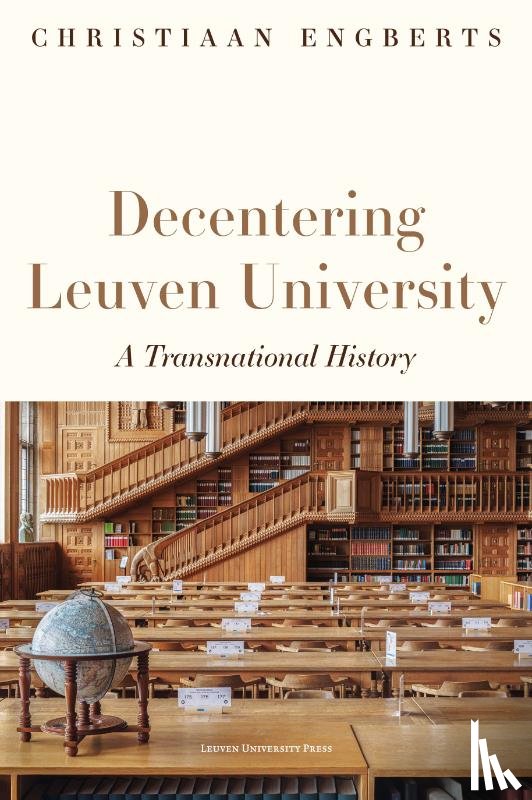
First longue durée transnational history of a university, surveying its cross-border ties and offering a new model for writing university history. Since its foundation in 1425, Leuven University has always been a transnational institution. Decentering Leuven University explores how this transnational character has shaped the university across six centuries, with cross-border ties emerging as a recurring theme throughout its history from the Middle Ages to the present day. However, these ties are more than just a recurring theme: they provide an innovative approach to writing university history. Taking the myriad cross-border ties as a methodological starting point makes it possible to view the history of the university from a new perspective. The rich variety of these ties highlights the complexity and diversity within the university. The author discusses, among other things, Leuven’s role as a center of European humanism in the 15th century, the significance of its Irish and Dutch mission colleges during the Counter-Reformation, the university’s more recent involvement in the Belgian colonial project, and the emergence of research institutes as hubs of transnational collaboration in the 20th century. Emphasizing these transnational ties leads to two forms of decentering the university’s history: it underscores the university’s embeddedness in a variety of cross-border networks, and it highlights the role of individual scholars, students, colleges, and research institutes in creating and maintaining these ties. Since its foundation in 1425, Leuven University has always been a transnational institution. Decentering Leuven University explores how this transnational character has shaped the university across six centuries, with cross-border ties emerging as a recurring theme throughout its history from the Middle Ages to the present day. However, these ties are more than just a recurring theme: they provide an innovative approach to writing university history. Taking the myriad cross-border ties as a methodological starting point makes it possible to view the history of the university from a new perspective. The rich variety of these ties highlights the complexity and diversity within the university. The author discusses, among other things, Leuven’s role as a center of European humanism in the 15th century, the significance of its Irish and Dutch mission colleges during the Counter-Reformation, the university’s more recent involvement in the Belgian colonial project, and the emergence of research institutes as hubs of transnational collaboration in the 20th century. Emphasizing these transnational ties leads to two forms of decentering the university’s history: it underscores the university’s embeddedness in a variety of cross-border networks, and it highlights the role of individual scholars, students, colleges, and research institutes in creating and maintaining these ties. Introduction
Universities, jubilees, and transnational ties
Introduction
The first university jubilees
Writing university history
Histories of Leuven University
The university in a transnational landscape
Leuven University from 1425 to 2025
Chapter 1
The transnational character of the early university
Introduction
Medieval universities before 1500
University, religion, and politics
The foundation of Leuven University
The recruitment of professors
Determining the geographical background of the early staff
The geographical background of professors in church law
The geographical background of professors in civil law
The geographical background of professors in medicine
The geographical background of professors in theology
The geographical background of professors in the arts
Determining the educational background of the early staff
The educational background of professors in church law
The educational background of professors in civil law
The educational background of professors in medicine
The educational background of professors in theology
The educational background of professors in the arts
A life after Leuven?
Conclusion: becoming self-sufficient
Chapter 2
Humanist entanglements
Introduction
Vives and Erasmus: Leuven’s early humanist luminaries
The networks of Vives and Erasmus
Humanism in Leuven before 1517
The foundation of the Collegium Trilingue
The (trans)national teaching staff of the Trilingue
A typical humanist: the research-minded traveler Campensis
A typical humanist: the printing endeavors of Rutgerus Rescius
A typical humanist: Petrus Nannius’s correspondence network
European students at the Trilingue
Trilingue students in Europe: the linguist Clenardus
Trilingue students in Europe: the diplomat Busbequius
Trilingue students in Europe: the anatomist Vesalius
An example worth following
Conclusion: a merging of university and humanist networks
Chapter 3
On the frontlines of faith
Introduction
Counter-Reformation and higher education in the seventeenth century
Leuven and the Irish college network
Irish history from Leuven
Irish Catholicism in Leuven
The precarious position of Catholicism in the northern Low Countries
Jesuits vs. Dutch secular clergy
Jesuits and the Leuven Augustinian tradition
Jesuits and Jansenists
St. Anthony’s, Pulcheria, and Alticollense
Toward the founding of an American College
The accomplishments of the American College
Leuven as an example of Catholicism and scholarship
Latin America in Leuven
Over four centuries of mission colleges
Chapter 4
Collections as transnational spaces
Leuven’s first central library
Catholic patristics and ecumenical medicine?
Collections, teaching, and research in the nineteenth century
The university collections in the mid-nineteenth century
The roots of the botanical garden
The botanical garden’s transnational branches
The birth of the zoological collection
Van Beneden’s transnational paleontological networks
The genesis of the Biblical Museum
A network of scholarly clergymen
The destruction of the library
International collaboration toward a new library
Reassembling the lost collection
The construction of a brand-new library
University collections and transnational networks
Chapter 5
The colonial involvement of Leuven University
Universities and colonialism
The first colonial programs at Belgian universities
A Catholic colonial student movement
Collecting the colony
After the First World War
First steps into the colony
The early expansion of FOMULAC: 1926-1931
The rapid expansion of FOMULAC: 1931-1945
Agricultural education in the Congo
Toward a university: University Centre Lovanium
The founding of a full university: Lovanium Kimwenza
Lovanium and Leuven University after Congolese independence
Leuven and Congo: a retrospective
Chapter 6
Research institutes as transnational hubs
The rise of research institutes
The Higher Institute of Philosophy
The laboratory for experimental psychology
The founding of the Husserl Archives
The growth of the Husserl Archives
Penicillin and the prelude to the Rega Institute
Polio vaccines and the founding of the Rega Institute
Developing viral treatments at the Rega Institute
Bananas come to Belgium
Banana research, conservation, and distribution in Leuven
The KU Leuven Institutes of the twenty-first century
Conclusion: research institutes between 1938 and 2025
Epilogue
Uniqueness and typicality
Change and continuity
Recent transnational developments
The merits and promise of transnational university histories
Notes